Shared authorization for the tools your team already runs.

Keep your delivery tools and connect each change’s authorization.

The CEED Framework gives your existing repository, testing, policy, deployment and production systems a shared approval record. Your team connects scope and evidence while each specialist tool keeps its job. The CEED Delivery Contract states the approved change, the CEED Router checks it at connected gates, and the CEED Change Passport keeps the history.

Give independently built tools the same authorization to read.

Those tools can work from records any compatible implementation can read. The CEED Delivery Contract and CEED Change Passport have published formats and decision rules. Integrations target the same model across teams and coding-agent vendors. Your approval history stays readable when tools change.

Requirements, Git, CI, security, deployment, observability and incident tools keep their responsibilities. The CEED Router uses their results to check the approved scope and evidence; the CEED Change Passport connects each decision to its source. These records can support automatic approval of a release's change request in IT change management tools such as ServiceNow or Jira Service Management, under your organization's change policy. Your team chooses and tests that connection. If release approval already happens in Git, put the CEED Router checks in branch protection and the deployment workflow, with no separate IT change management connection.

See what the dated tool review established.

The September 9, 2026 CEED Tool Verification Matrix assessed documented capabilities in specified product scopes and configurations across 23 technologies. It found separate capabilities, but no documented supplied model combining issued per-change authority, allowed, protected and unlisted paths, exact-candidate and deployment binding, and continuing production history.

Each building block is familiar: required checks, protected branches, authenticated provider APIs and deployment waits. The CEED Framework's contribution is what they enforce together: every file outside a change's approved scope is blocked by default, the approval is bound to the exact revision, and it travels through each required release checkpoint into production findings. Building that combination privately means designing and maintaining the rules the CEED Specification already publishes. Why teams use the published rules instead of building their own →

The CEED Framework connects those parts through the CEED Delivery Contract, CEED Change Passport and shared decision rules. Implementations test the applicable CEED Conformance Pack cases against that common target.
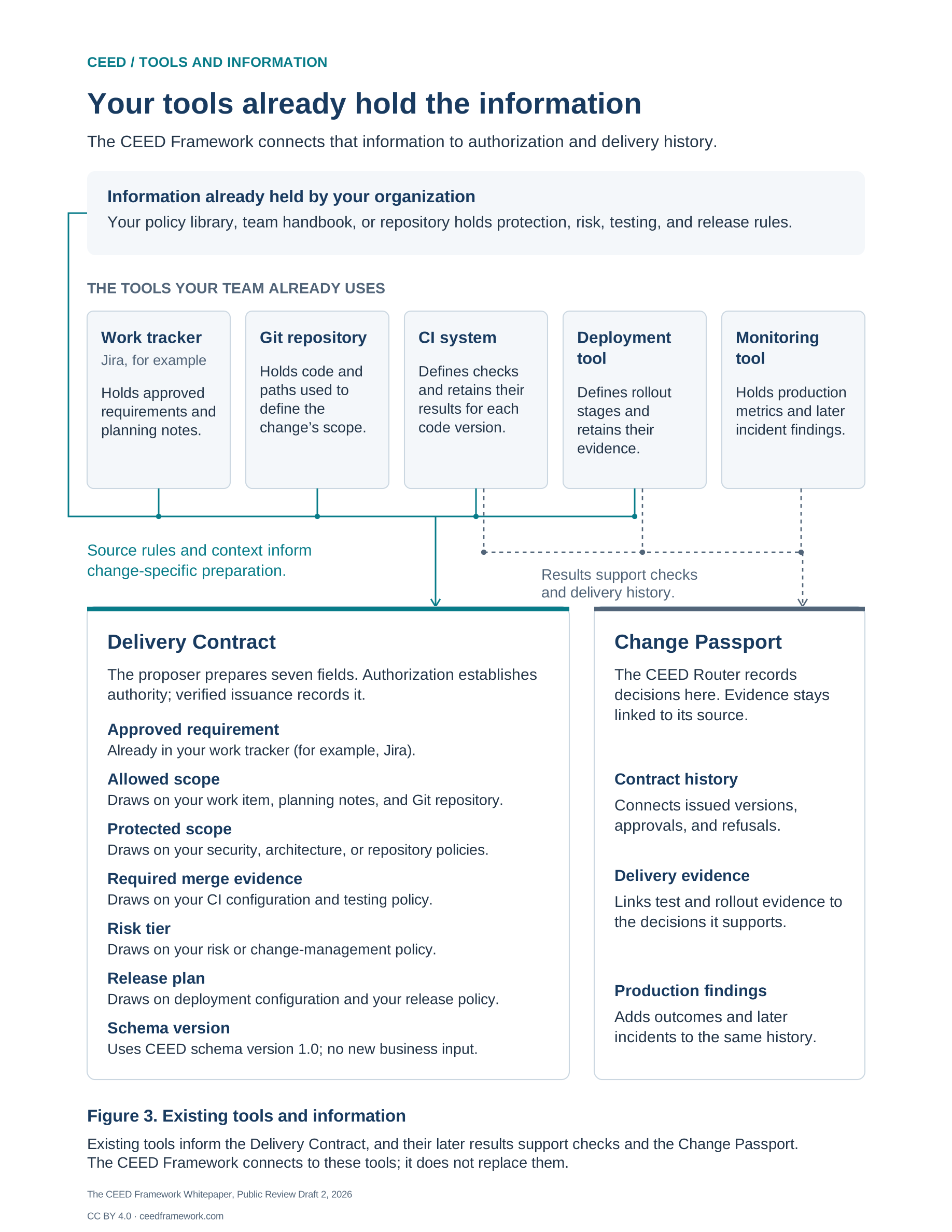
Use familiar tools to implement the shared rules.

The tools in that comparison can supply the implementation's building blocks. The CEED Specification defines how their facts connect to one approved change. Your platform team chooses integrations for its environment, the CEED Router checks the configured gates, and the CEED Change Passport keeps the decisions.

01

Make repository merges wait for authorization

Git platforms can protect CEED Delivery Contract issuance paths and require the CEED Router's merge decision. The governed merge path waits for approval.

02

Apply published rules with an existing policy engine

OPA or Conftest can evaluate policy within a CEED implementation. The CEED Specification supplies the common approval rules and record model.

03

Bind evidence to the artifact or event being checked

The in-toto Attestation Framework can carry evidence bound to its subject. Optional signing and verification tools can authenticate selected statements. The implementation can identify the source and subject of each record.

04

Keep deployment execution in the existing platform

Deployment and exposure platforms run the rollout. The CEED Router checks the approved strategy and required evidence at each checkpoint. The platform proceeds under that change's release conditions.

05

Share event notifications while retaining one change history

CDEvents can carry lifecycle notifications between tools. The CEED Change Passport remains the governing change history; the event messages do not change what that record means.

06

Read local reports in the analytics tools you already use

Your analytics tools can read the CEED Router's local report output. Your team can examine the defined measures in the tools it already uses.

DATED EVIDENCE RECORD

Inspect the dated evidence behind the tool comparison.

The CEED Tool Verification Matrix records whether the reviewed technologies supplied the full specified combination in the configurations assessed on September 9, 2026, so anyone can check each cited finding and its public correction record.

Read the CEED Tool Verification Matrix on the Publications page to inspect the methods, configurations, and findings.

Try the shared model on one change with your existing tools.

Use CEED in Practice to prepare a CEED Delivery Contract and compare it with the actual files and evidence for one change. That trial gives your team a concrete starting point for its next integration decision.

Run the first process trial →