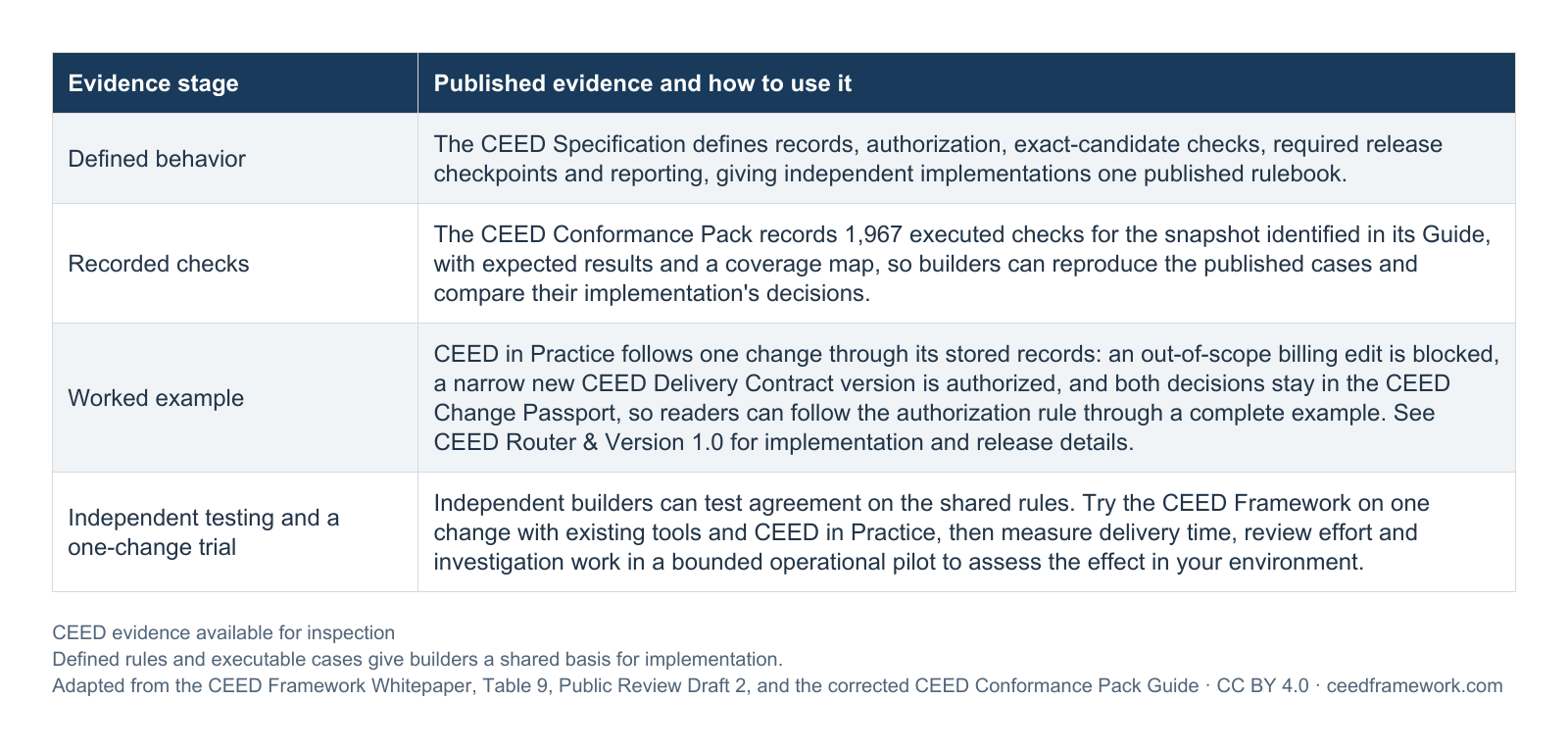
Inspect the CEED Specification, the CEED Conformance Pack's 1,967 executed checks, and the illustrative change in CEED in Practice. The rules, expected results and coverage map show how approval becomes a recorded delivery decision. You can judge the design now, reproduce the checks and try one change with your existing tools.
Start with the design. The CEED Framework applies established security and audit practices to AI-written change: independent approval, protected authority, exact-revision checks, fail-closed gates and append-only history. The CEED Specification defines those rules, and the CEED Conformance Pack's coverage map identifies the rules its executable cases test. A builder then tests its own implementation and connected gates. Your trial and pilot measure the effect on your delivery work. Each step answers a different question, and you can begin with the published design today.
Next, reproduce the recorded run. The corrected CEED Conformance Pack Guide identifies the exact published snapshot, 1,967 executed checks on synthetic cases, expected results and a coverage map. Builders use the applicable inputs and expected results to test their own implementation and retain that comparison as separate evidence.
Read the corrected CEED Conformance Pack Guide →The CEED Delivery Contract and CEED Change Passport are machine-readable structures. Independently built tools can produce and read the same records.
The packaged cases execute identified deterministic rules. Builders can test their implementation against the same expected decisions.
The published report calculations reproduce for the supplied fixtures. Anyone can recompute those figures.
Known inconsistencies between the CEED Specification, schemas, examples and runners are treated as defects. Each correction identifies the affected artifact, so builders can see what changed.
The CEED Conformance Pack Guide sets out the commands, expected results and interpretation for the published package.