CEED FRAMEWORK

How It Works

Approve the scope once. Every code fix is checked automatically.

Decide the scope once, before coding. The issued CEED Delivery Contract covers every later fix while its authority stays valid and unchanged, and the CEED Router checks each exact revision and required release stage against it and records the result. Templates, scripts or an AI tool can prepare the proposal. Protected automation approves eligible routine work after the required checks, normally including a review by an AI service separate from the coding agent. An independent person approves sensitive work and exceptions. The coding agent cannot choose an easier route or approve its own scope. A wider scope needs a newly approved and issued version. Teams already make these decisions in tickets, prompts and reviews; the CEED Framework moves them earlier and records them.

Follow the approval from the requirement to production.

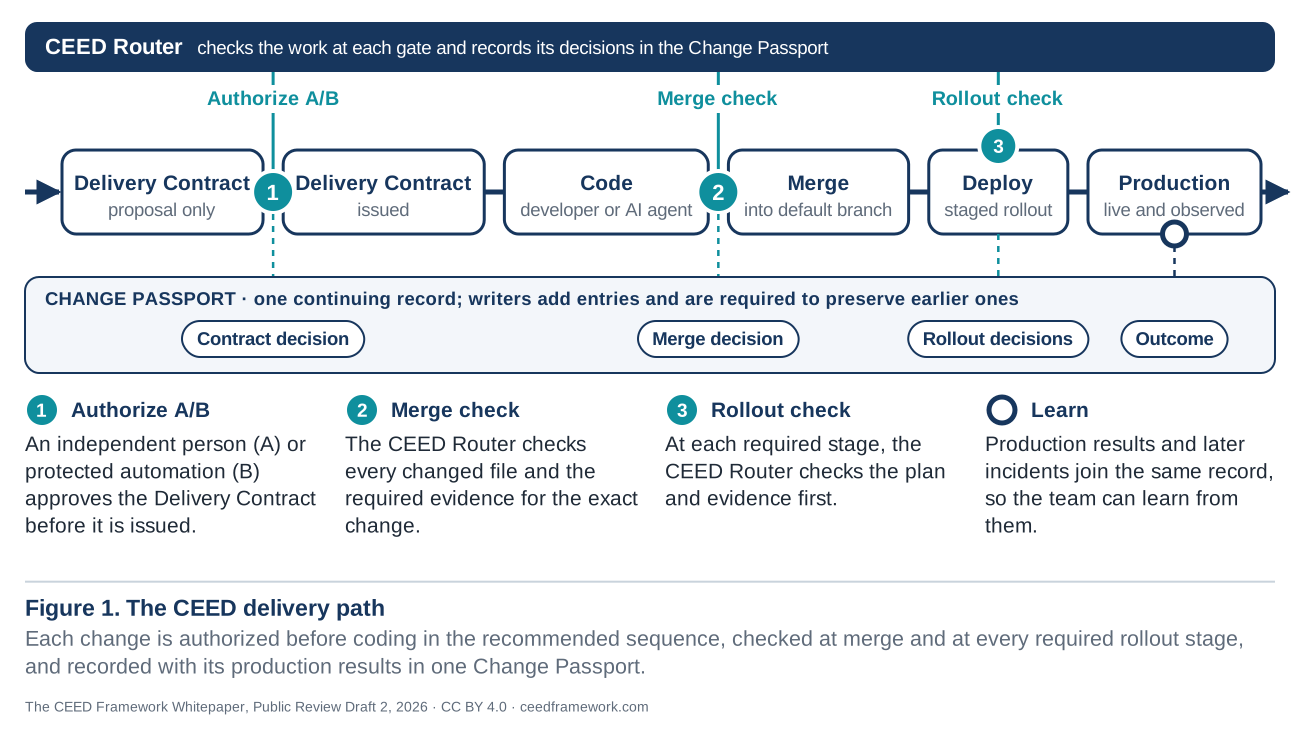
That issued CEED Delivery Contract governs the change from merge to rollout. The CEED Router checks the complete changed-file set for the exact base and head revisions and binds required evidence to that candidate. Rebases, squash merges and merge queues receive the checks for the actual candidate or final commit. Release evidence must match the deployment event and required stage; the approved strategy and checkpoint order apply. Mandatory connected gates wait until approval is established and the decision is stored. Missing or invalid approval or evidence keeps the gate closed. Reporting runs separately and does not block delivery. In the recommended sequence, issuance precedes coding; every CEED-approved merge or release requires an issued CEED Delivery Contract.

The seven steps below show how those checks fit your delivery path. Implement the CEED Specification with your existing tools, or use a suitable CEED Router. Keep the CEED Delivery Contract and CEED Change Passport formats and test the applicable CEED Conformance Pack cases against your implementation. Start with a process trial using CEED in Practice and your current approvals, then connect the gates in a pilot. See CEED Router & Version 1.0 for the CEED Project's Git and GitHub implementation and release details.
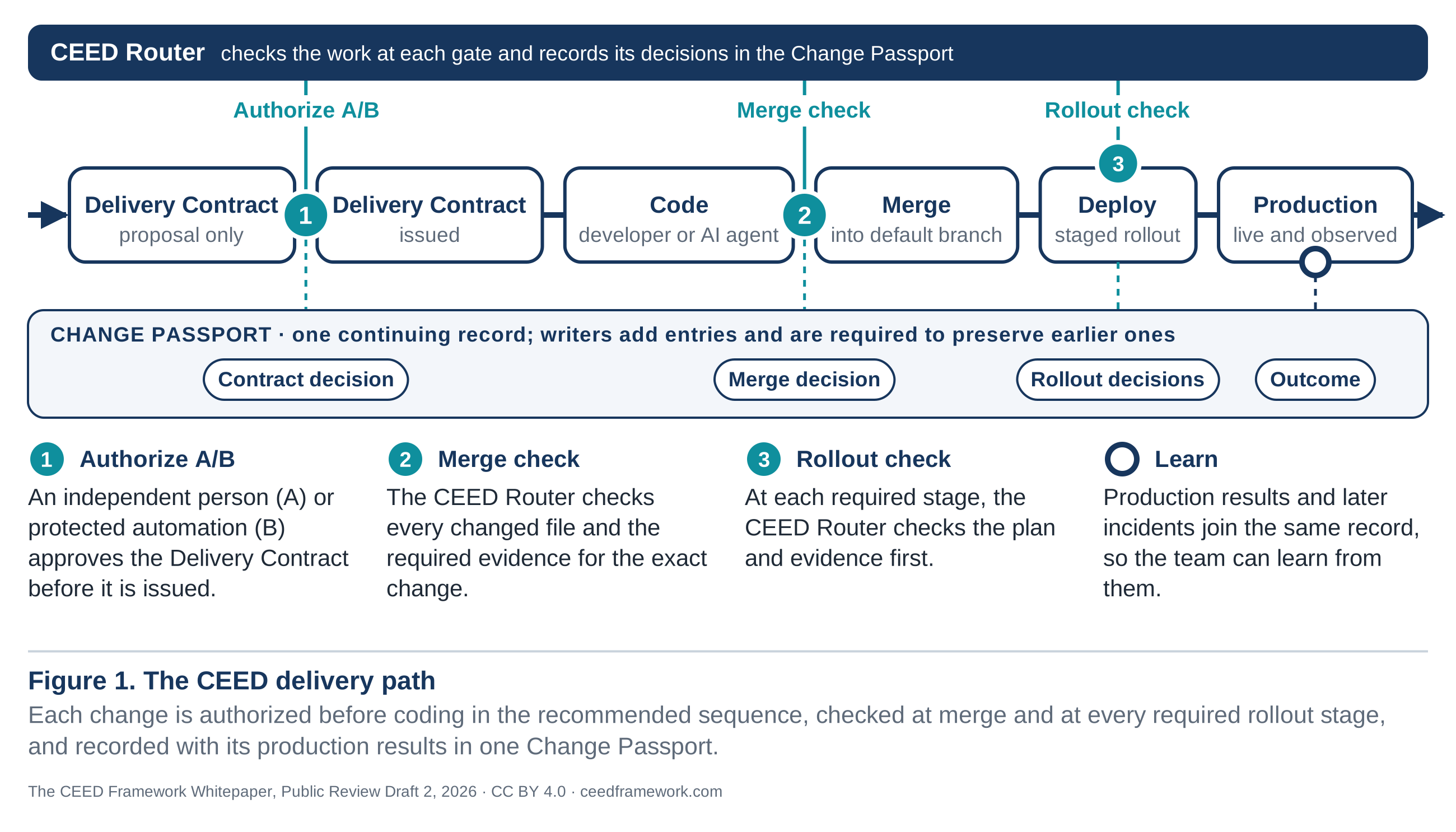
Each step adds a recorded decision, so the approval travels with the change.

Follow one change from its approved requirement through authorization, merge, release, and production history to see which decisions people make and which checks automation repeats.

01

Start with work the organization has approved

The organization’s existing work-management system holds the approved requirement, giving the CEED Delivery Contract an authoritative purpose to reference.

02

Record the scope before implementation begins

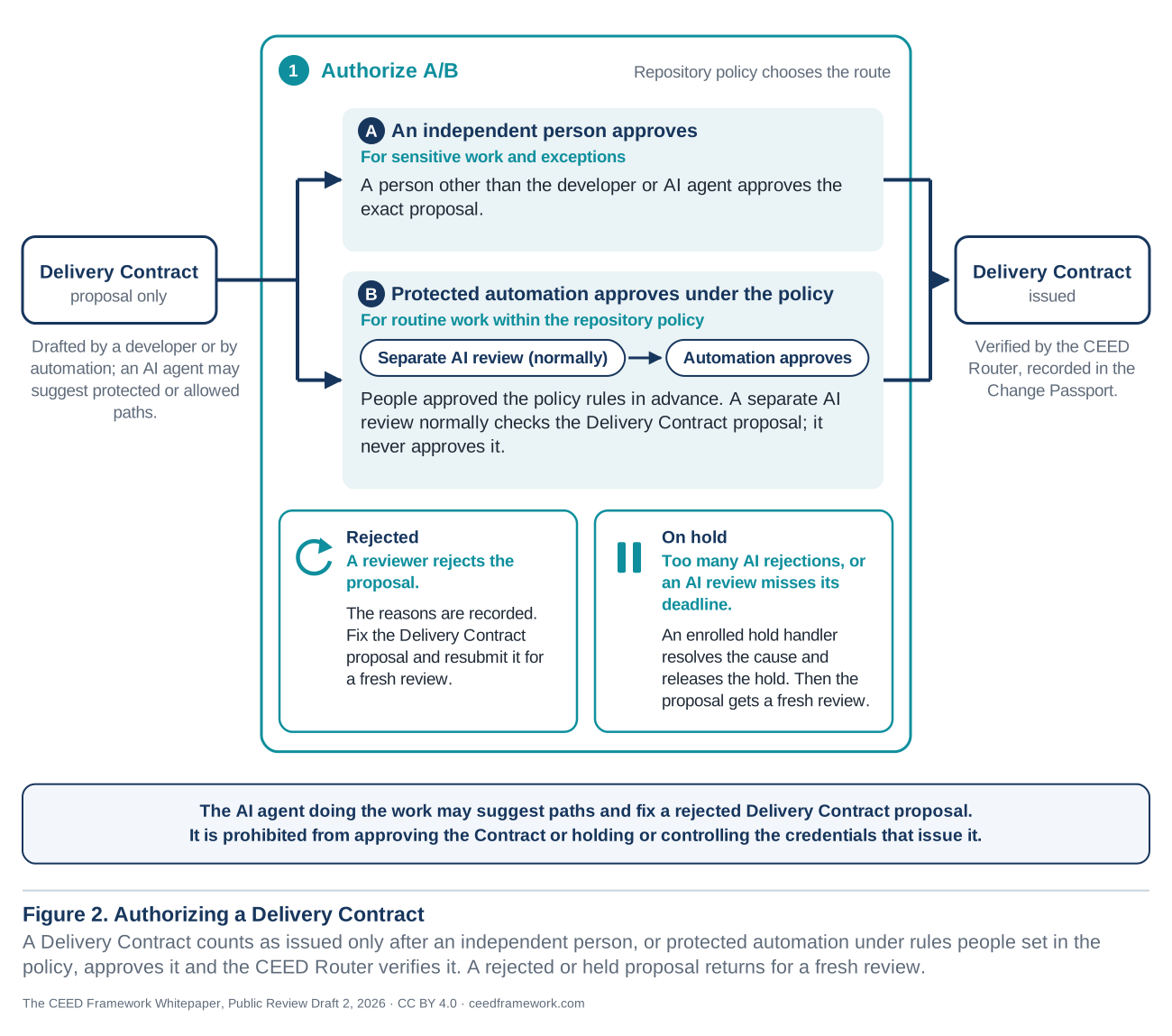
A person, script or AI tool proposes the CEED Delivery Contract. Protected policy sends eligible routine work to automation and sensitive work and exceptions to an independent person. After the CEED Delivery Contract lands in its own change, the CEED Router verifies that exact approved version and records issuance. Developers and gates then have one issued record of scope, evidence, risk and release conditions.

03

Write the code and produce the required evidence

Engineers and AI agents write the change. Existing test and security tools produce the evidence the CEED Delivery Contract requires. Your team keeps its established implementation checks.

04

Check the exact revision before allowing merge

The CEED Router compares the exact candidate and its required evidence with the issued CEED Delivery Contract. It records approved, review-required or blocked. Only approved lets the governed merge proceed. The other decisions identify the review, correction, evidence or newly issued approval needed before another check can approve the change.

05

Verify each required release stage before proceeding

The CEED Router checks the approved strategy, stage order and evidence for the exact deployment checkpoint. The deployment platform proceeds when the required conditions hold and the approval is recorded.

06

Record what happened after release

The authorized production integration records healthy, incident or inconclusive for the observation period. Reviewers can distinguish a supported outcome from missing or unclear evidence.

07

Add new findings without erasing earlier decisions

The CEED Change Passport adds later incident links and corrections. Investigators see the earlier conclusion and the new findings together.

WHO AUTHORIZES THE CONTRACT

Routine work proceeds under rules people set. Sensitive work goes to a person.

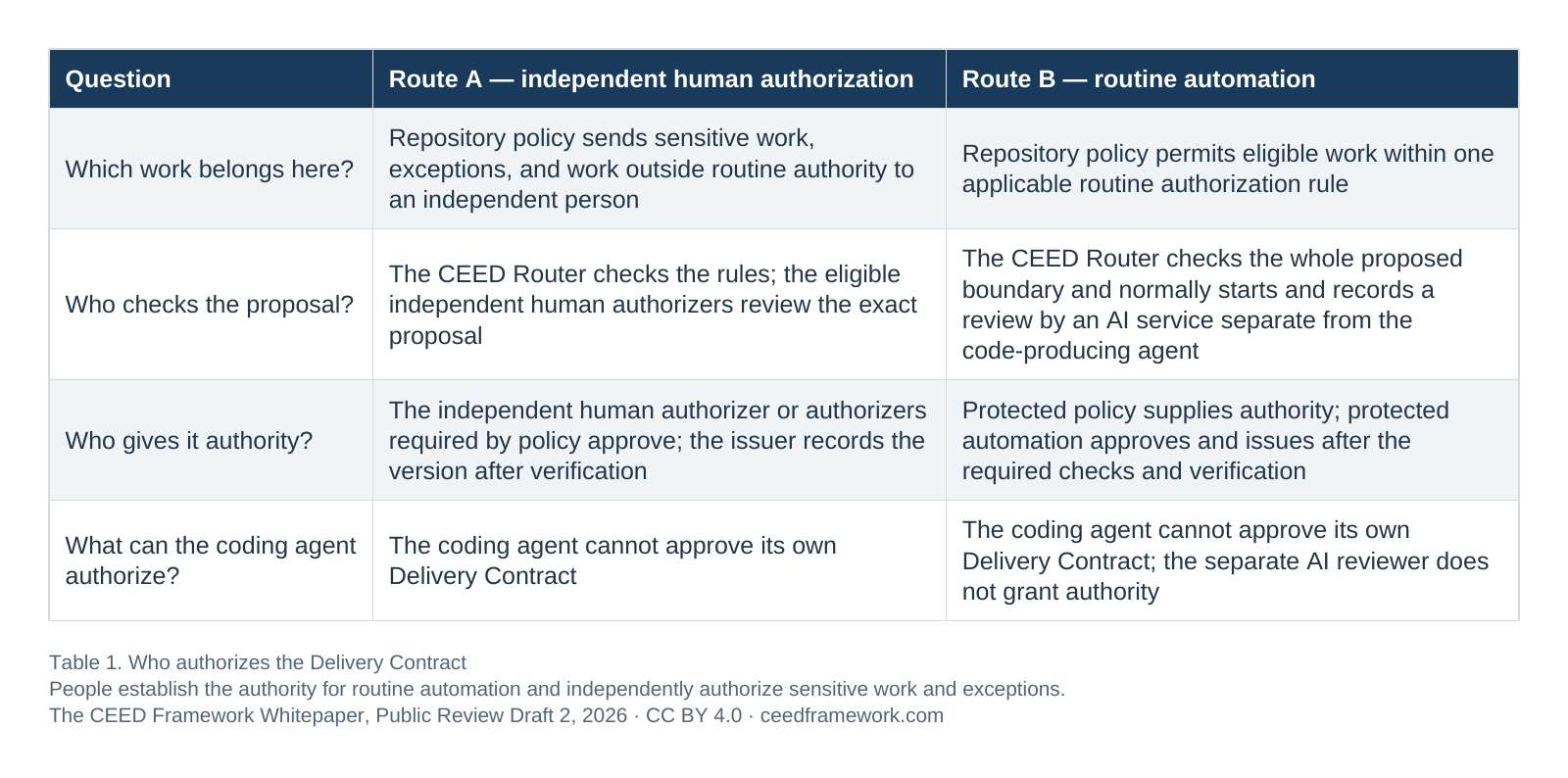
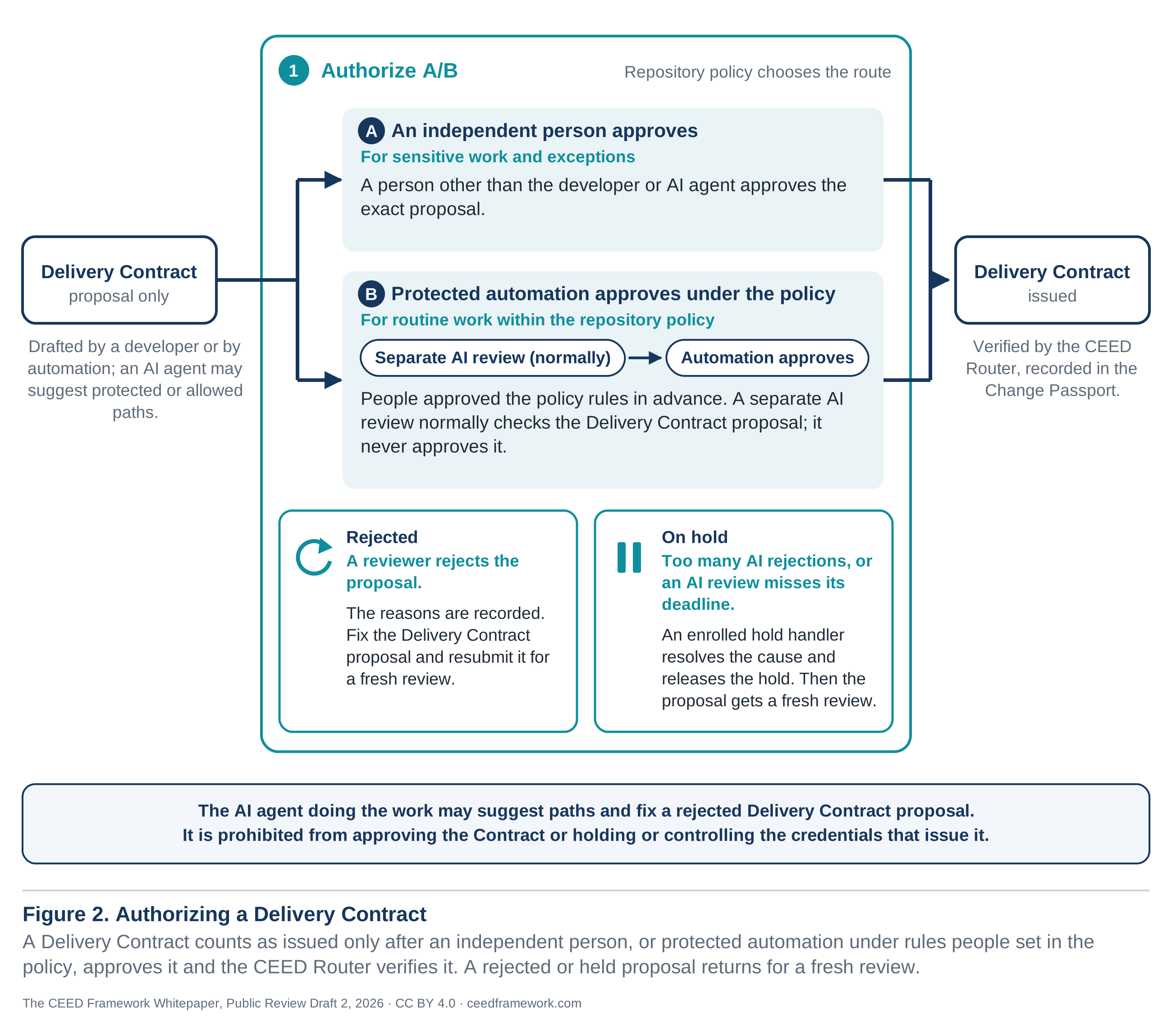
The sequence depends on a clear approval route. Protected repository policy assigns each CEED Delivery Contract proposal to an independent person or eligible routine automation. The coding agent cannot choose a different route. The CEED Router verifies the assigned route and the exact approved version before issuance.

In the illustrative REQ-1432 change, protected automation issues CEED Delivery Contract version 1 after a separate AI review. The billing-file exception needs the independent engineering lead's approval of version 2. The rest of billing stays protected. Protected policy can permit mechanical-only checks for narrowly defined routine work; the coding agent never chooses the review method.

Question
Route A — independent human authorization
Route B — routine automation
Which work belongs here?
Route A — independent human authorization
Repository policy sends sensitive work, exceptions, and work outside routine authority to an independent person
Route B — routine automation
Repository policy permits eligible work within one applicable routine authorization rule
Who checks the proposal?
Route A — independent human authorization
The CEED Router checks the rules; eligible independent human authorizers review the exact proposal.
Route B — routine automation
The CEED Router checks the whole proposed boundary and normally obtains a recorded review from an AI service separate from the coding agent.
Who gives it authority?
Route A — independent human authorization
The independent human authorizer or authorizers required by policy approve; the issuer records the version after verification
Route B — routine automation
Protected policy supplies authority; protected automation approves and issues after the required checks and verification
What can the coding agent authorize?
Route A — independent human authorization
The coding agent cannot approve its own CEED Delivery Contract
Route B — routine automation
The coding agent cannot approve its own Delivery Contract; the separate AI reviewer does not grant authority
Table 1. Who authorizes the CEED Delivery Contract
People establish the authority for routine automation and independently authorize sensitive work and exceptions.
The CEED Framework Whitepaper, Public Review Draft 2, 2026 · CC BY 4.0 · ceedframework.com
Download:PNGPDF

Every proposal follows one authorization route, and every rejection records what to fix.

Resolve objections before resubmitting a rejected proposal.

A completed authoritative rejection records the objections for the proposer to address before fresh review. If a required AI review is overdue or completed AI rejections reach the policy limit, the CEED Router holds issuance and automatic resubmission. An enrolled person resolves the cause and records the release of the hold. That release restarts the required approval process; it does not approve a CEED Delivery Contract.

Read how the routes work in Chapter 2 of the Whitepaper (PDF) →

Follow a blocked billing edit through a narrow approval and release.

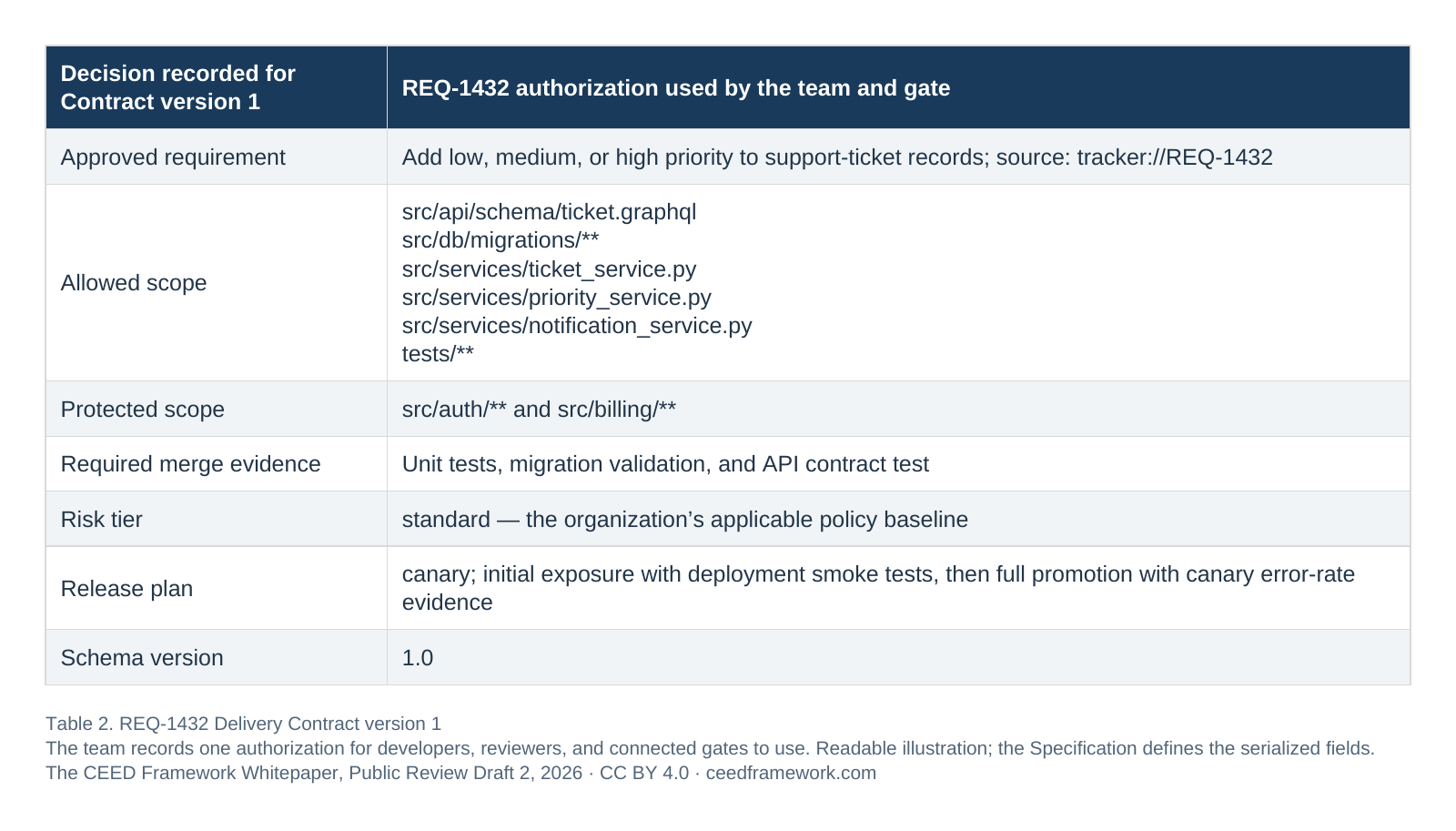
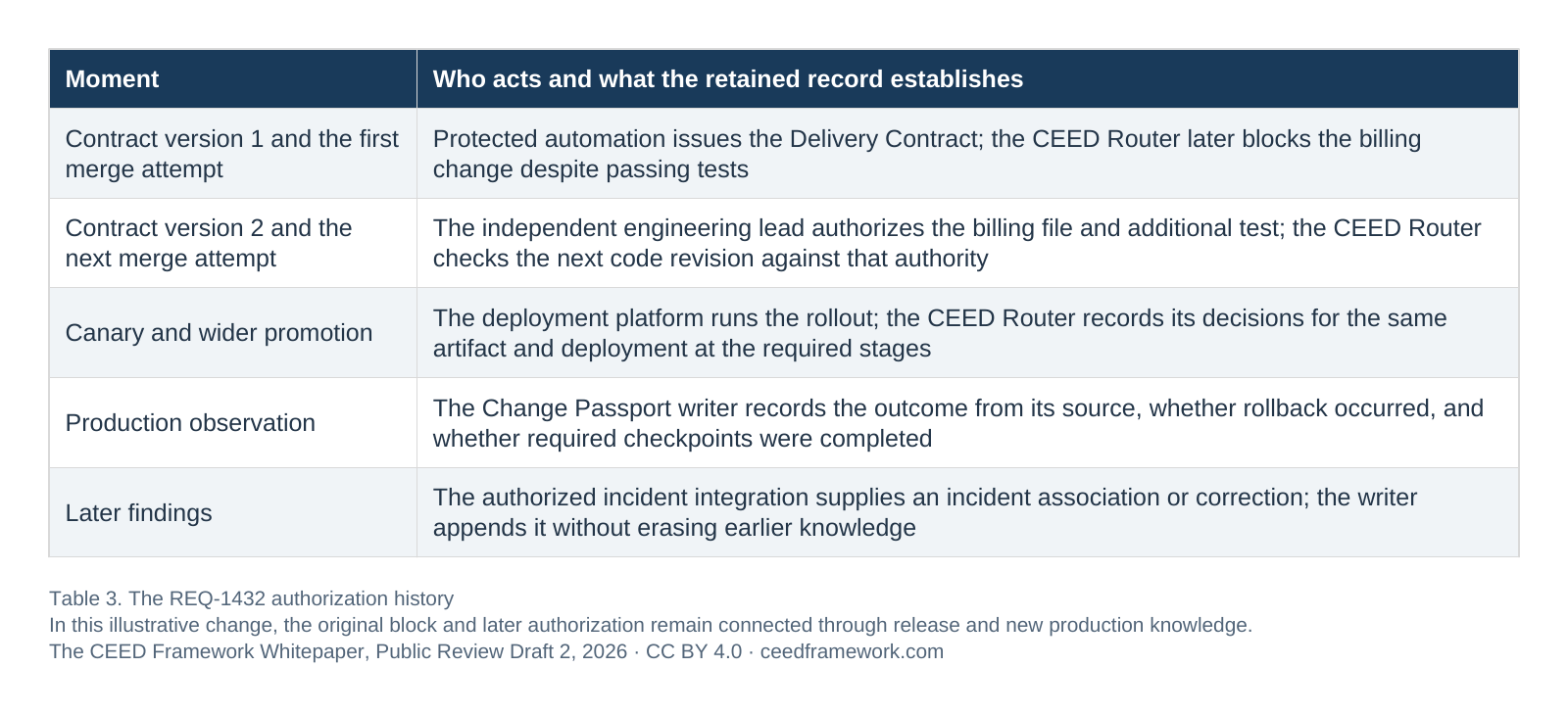
The illustrative REQ-1432 change uses both routes. A ticket-priorities feature encounters an unapproved billing edit, then proceeds under a narrow independent approval. Tables 2 and 3 connect the approved scope to the decisions retained through release and investigation.

Decision recorded for CEED Delivery Contract version 1
REQ-1432 authorization used by the team and gate
Approved requirement
REQ-1432 authorization used by the team and gate
Add low, medium, or high priority to support-ticket records; source: tracker://REQ-1432
Allowed scope
REQ-1432 authorization used by the team and gate
src/api/schema/ticket.graphql
src/db/migrations/**
src/services/ticket_service.py
src/services/priority_service.py
src/services/notification_service.py
tests/**
Protected scope
REQ-1432 authorization used by the team and gate
src/auth/** and src/billing/**
Required merge evidence
REQ-1432 authorization used by the team and gate
Unit tests, migration validation, and API contract test
Risk tier
REQ-1432 authorization used by the team and gate
standard — the organization’s applicable policy baseline
Release plan
REQ-1432 authorization used by the team and gate
canary; initial exposure with deployment smoke tests, then full promotion with canary error-rate evidence
Schema version
REQ-1432 authorization used by the team and gate
1.0
Table 2. REQ-1432 CEED Delivery Contract version 1
The team records one authorization for developers, reviewers, and connected gates to use. Readable illustration; the CEED Specification defines the serialized fields.
The CEED Framework Whitepaper, Public Review Draft 2, 2026 · CC BY 4.0 · ceedframework.com
Download:PNGPDF

Every decision on REQ-1432 stays in one CEED Change Passport history.

Moment
Who acts and what the retained record establishes
CEED Delivery Contract version 1 and the first merge attempt
Who acts and what the retained record establishes
Protected automation issues the Delivery Contract; the CEED Router later blocks the billing change despite passing tests
Delivery Contract version 2 and the next merge attempt
Who acts and what the retained record establishes
The independent engineering lead authorizes the billing file and additional test; the CEED Router checks the next code revision against that authority
Canary and wider promotion
Who acts and what the retained record establishes
The deployment platform runs the rollout; the CEED Router records its decisions for the same artifact and deployment at the required stages
Production observation
Who acts and what the retained record establishes
The CEED Change Passport writer records the outcome from its source, whether rollback occurred, and whether required checkpoints were completed
Later findings
Who acts and what the retained record establishes
The authorized incident integration supplies an incident association or correction; the writer appends it without erasing earlier knowledge
Table 3. The REQ-1432 authorization history
In this illustrative change, the original block and later authorization remain connected through release and new production knowledge.
The CEED Framework Whitepaper, Public Review Draft 2, 2026 · CC BY 4.0 · ceedframework.com
Download:PNGPDF
WHAT ADOPTION CHANGES

Decide scope once. Let the pipeline apply it at every gate.

Teams already decide scope in tickets, prompts and reviews. The CEED Framework records that decision in the CEED Delivery Contract before coding, and agents and gates reuse it. A scope correction at that stage changes the plan before it becomes code.

See why early, reusable authorization helps →See who proposes, authorizes and checks, and how CEED fits Scrum, Kanban or SAFe →

Give reviewers and gates the same approved scope

The CEED Delivery Contract records the requirement, scope, evidence, risk and release conditions in one approved version. Protected policy assigns routine work to automated issuance and sensitive work and exceptions to an independent person. Developers, reviewers and gates use the same issued approval.

Make an unapproved extra file an explicit scope decision

The CEED Router identifies changed files outside the issued approval. The team removes an unnecessary edit or proposes a new CEED Delivery Contract version through the assigned route. The CEED Change Passport keeps both decisions and the reason the approval changed.

Identify overlapping changes before a combined build

Where the platform supports early batch admission, the CEED Router identifies overlapping files and incompatible release rules before a combined build. The platform can leave incompatible changes out. The actual final batch still receives its required check.

Follow the original approval during an investigation

The CEED Change Passport links the issued CEED Delivery Contract, decisions, evidence references, release checkpoints and later findings. An investigator follows that history to retained source records.

Set up once. Approve each scope once. Check every revision automatically.

The CEED Specification supplies the shared rules. Platform owners implement and maintain policy, integrations, gate configuration and record retention. Each issued CEED Delivery Contract version supplies approval that later fixes reuse, and each new candidate and required release stage gets its own check.

01

Maintain shared setup for the repository’s changes

Platform owners protect policy and credentials, connect source and evidence systems, and make merge and required release gates wait for CEED Router decisions. They maintain policy, integrations, retention and the internal Enforcement Coverage Declaration. Later changes use the same controlled path, with verified coverage kept current.

02

Authorize a scope version that later checks can reuse

In the recommended sequence, the CEED Delivery Contract is approved and issued before coding, so a scope correction changes the plan and not the code. Templates and AI-assisted drafts give the assigned authorizer a concrete proposal. Changed authority requires a newly approved and issued version, with the earlier decision retained.

03

Check the exact candidate and required release evidence

The CEED Router uses existing test, scan and deployment results to check each exact candidate and required rollout stage. Your specialist tools keep doing their jobs. The CEED Change Passport retains the decisions.

Prepare the scope with AI assistance and keep authorization independent.

The same issued CEED Delivery Contract can guide the coding agent and govern the delivery gates. Preparation and enforcement use one approved file boundary.

Prepare a CEED Delivery Contract draft for the assigned authorizer.

Templates and scripts fill recurring fields. An AI tool can propose change-specific scope from the approved requirement, repository and policy. Reviewers get a concrete draft. Protected requirement and policy context determine the approval route; the coding agent cannot choose easier authority or approve its own proposal.

Show the approved file boundary before the agent edits.

A command-line, editor or agent integration can show the issued CEED Delivery Contract before the agent edits. That guidance helps it stay within the approved file boundary. The CEED Router independently checks the exact candidate at the delivery gate.

Use the worked records and rules to plan a trial.

Use these sources to plan that first trial. CEED in Practice supplies the illustrative records and trial method. The CEED Specification defines the requirements, and the Whitepaper explains the case for adoption.

Use a pilot to measure delivery performance.

After the process trial, run a bounded pilot. Measure gate time, concurrency, approval waiting, recovery and total delivery effort against your current delivery path, then decide on wider adoption.

Try the CEED Framework on one change this week, with no new software.

Prepare and review the CEED Delivery Contract with existing tools and approvals, then compare the actual work with the proposed scope to decide what the next trial should test.

Run the process trial in CEED in Practice →